
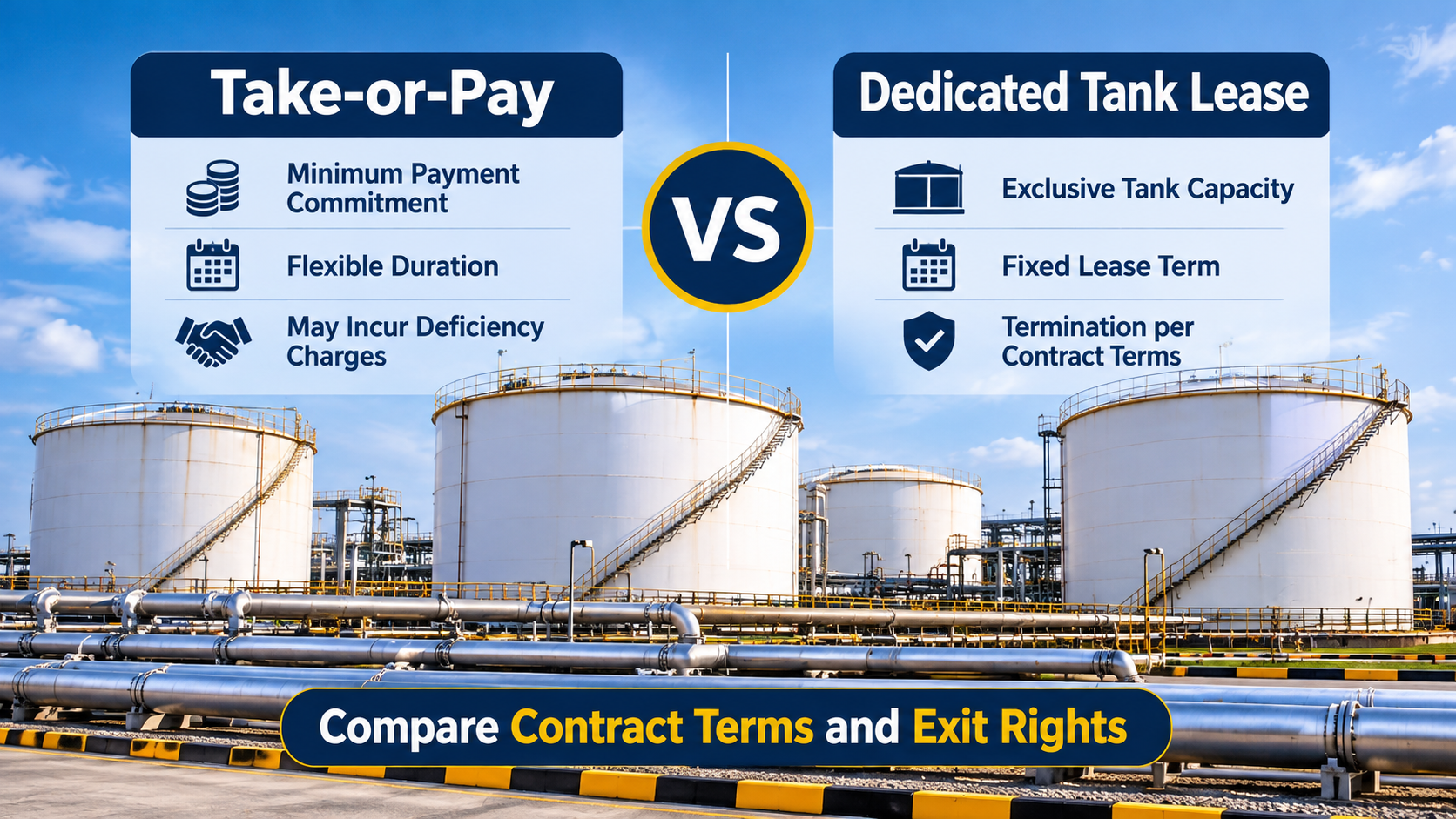
Take or Pay vs a Dedicated Tank Lease: Compare Term and Exit Terms
Choosing between a take-or-pay agreement and a dedicated tank lease is an important commercial decision for businesses involved in petroleum storage, oil trading and bulk liquid logistics.
Although both arrangements provide access to storage capacity, they differ in payment obligations, contract duration, operational flexibility and termination rights. Understanding these differences helps businesses manage costs, reduce contractual risks and choose the most suitable storage arrangement.
1. What Is a Take-or-Pay Agreement?
A take-or-pay agreement is a commercial arrangement in which a customer commits to paying for an agreed minimum quantity of storage, throughput or handling services, whether or not the full contracted volume or capacity is used.
For example, an oil trader may agree to a minimum monthly throughput of 10,000 cubic metres. If the trader uses less than the agreed volume, the minimum payment obligation may still apply.
Some agreements include make-up rights, allowing customers to recover previously paid but unused volumes within an agreed period, subject to contractual conditions.
Key characteristics:
- Payment is based on a minimum contractual commitment.
- Actual usage may be lower than the committed volume.
- Make-up rights may provide additional flexibility.
- Contract duration is agreed in advance.
- Early termination may involve financial penalties or outstanding payment obligations.
Take-or-pay agreements are suitable for businesses that require reliable access to terminal capacity but do not necessarily need exclusive use of a particular tank.
2. What Is a Dedicated Tank Lease?
A dedicated tank lease is an arrangement under which a customer secures exclusive use of a specified storage tank or group of tanks for an agreed period.
Unlike a take-or-pay agreement, which focuses on minimum payment or volume commitments, a dedicated tank lease focuses on reserving a particular storage asset for the customer’s use.
For example, a petroleum trading company may lease a 5,000-cubic-metre tank at a terminal for 12 months. The company pays the agreed rental or storage fee throughout the contract, even when the tank is not fully utilised.
However, not every dedicated storage agreement is legally a lease. Depending on its structure and the applicable law, it may instead be classified as a storage or terminal-services agreement.
Key characteristics:
- A specific tank or storage facility is allocated to the customer.
- Exclusive-use rights are generally provided.
- Fixed rental or storage charges may apply.
- The customer has greater control over allocated storage space.
- Early termination may require notice, compensation or payment of outstanding rental obligations.
Dedicated tank arrangements are particularly suitable for businesses handling specialised products, maintaining separate product specifications or requiring guaranteed access to specific storage infrastructure.
3. Comparing Contract Terms and Exit Conditions
The main differences between these arrangements become clearer when comparing their contract duration, payment obligations and termination provisions.
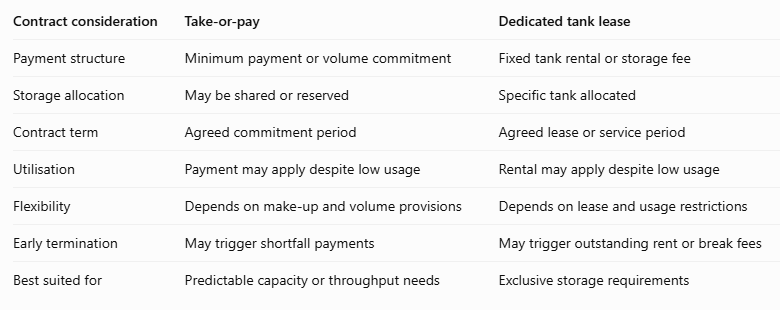
Contract Duration
Take-or-pay agreements commonly use monthly, annual or multi-year minimum commitments. The contract should clearly define the committed volume, billing period, renewal arrangements and any make-up period.
Dedicated tank leases may also run for several years, particularly where the customer requires exclusive access to storage infrastructure.
In both cases, businesses should negotiate a contract duration that reflects their operational forecasts and expected demand.
Exit and Termination Terms
Exit provisions are among the most important clauses to review before signing either arrangement.
Under a take-or-pay agreement, customers may remain responsible for minimum payment obligations until the contractual commitment expires. Depending on the agreement, early termination may also trigger shortfall payments or additional compensation.
Under a dedicated tank lease, early exit may require payment of outstanding rent, a break fee or compensation for the remaining contractual period.
Both agreements should clearly address:
- Notice periods for termination.
- Early termination fees and outstanding payments.
- Material breach and failure to provide services.
- Prolonged force majeure events.
- Tank maintenance and operational unavailability.
- Contract renewal and expiry procedures.
- Product removal, tank cleaning and handover obligations.
A well-negotiated exit clause can prevent unexpected financial exposure when business requirements change.
4. How Country Differences Affect These Agreements
Although the commercial principles of take-or-pay agreements and dedicated tank leases are broadly similar internationally, their legal treatment and regulatory requirements can differ.
Businesses should consider the applicable national laws, petroleum regulations and jurisdiction specified in their contracts.
United Kingdom
In the UK, the distinction between a genuine lease and a storage services agreement can have important legal and accounting consequences.
The contractual arrangement should clearly establish whether the customer has exclusive rights to use an identified tank or is simply purchasing storage services.
Businesses should consider:
- Applicable contract and property laws.
- Environmental and petroleum storage requirements.
- Lease classification and accounting treatment.
- Contractual notice periods and break clauses.
- Liability for environmental damage and product contamination.
A dedicated tank arrangement should not automatically be treated as a property lease simply because a specific tank is allocated to a customer.
United States
In the United States, contractual treatment may vary depending on the state, petroleum product and regulatory framework governing the facility.
Take-or-pay commitments are used in certain terminal and energy infrastructure contracts, particularly where operators require predictable revenue to support reserved capacity.
Businesses should review:
- Applicable state contract and commercial laws.
- Federal and state environmental requirements.
- Pipeline and terminal operating regulations, where applicable.
- Minimum volume commitments and make-up rights.
- Early termination payments and liability limitations.
For companies operating across multiple states, it is important to establish which jurisdiction governs the agreement and how disputes will be resolved.
Other International Markets
In other markets, the interpretation of storage agreements may depend on local commercial law, property law, petroleum regulations and the contractual structure.
International businesses should pay particular attention to governing law, dispute resolution, currency arrangements, tax obligations and cross-border enforcement.
These differences make it important to obtain appropriate local legal advice before entering into long-term storage commitments.
5. Which Arrangement Is Better for Your Business?
The right option depends on how frequently your business uses storage facilities, the level of operational control required and your willingness to accept long-term financial commitments.
A take-or-pay agreement may be more suitable if:
- Your business requires regular terminal access.
- You can forecast minimum monthly or annual throughput.
- You do not require exclusive use of a particular tank.
- You can negotiate reasonable make-up rights.
- You prefer a capacity or service commitment rather than a specific tank lease.
A dedicated tank lease may be more suitable if:
- You require exclusive storage capacity.
- Your products must be kept separate from other customers’ products.
- You need greater control over a specific storage facility.
- You have consistent demand for the tank.
- You can justify the fixed rental cost over the contract period.
Ultimately, businesses should compare the total financial commitment, operational benefits and exit costs rather than focusing solely on the initial storage price.
6. Key Contract Clauses to Negotiate Before Signing
Regardless of the arrangement selected, businesses should carefully negotiate the following provisions:
- Contract duration: Define the initial term, renewal options and expiry date.
- Payment obligations: Clarify fixed fees, minimum volume commitments and additional charges.
- Termination rights: Establish acceptable reasons for early termination and the applicable notice period.
- Break clauses: Negotiate whether either party can exit before the contract expires and at what cost.
- Force majeure: Specify how extraordinary events affect payment obligations and termination rights.
- Operational performance: Define tank availability, maintenance responsibilities and service standards.
- Product handling: Establish responsibility for contamination, losses, tank cleaning and product removal.
- Dispute resolution: Specify the governing law, dispute resolution procedure and appropriate jurisdiction.
These provisions help protect both the storage operator and the customer against unexpected commercial and operational risks.
Conclusion
Take-or-pay agreements and dedicated tank leases both provide ways to secure petroleum storage capacity, but they serve different commercial purposes.
A take-or-pay arrangement is generally more appropriate for businesses seeking guaranteed capacity or throughput under a minimum payment commitment. A dedicated tank lease is better suited to businesses that require exclusive access to a specific storage facility.
The most important considerations are contract duration, payment obligations, operational flexibility and exit costs.
Before signing, businesses should carefully review the termination provisions and ensure that their agreements comply with applicable laws and petroleum storage regulations in their operating jurisdictions.
Choosing the right structure can help businesses control storage costs, protect operational continuity and build more sustainable logistics arrangements.