

Cargo Ullage Disputes: How to Check Discharge Against Load-Port Records
Cargo ullage disputes are common in petroleum shipping and bulk liquid transportation, particularly when the quantity recorded at the discharge port differs from the quantity documented at the loading port.
Even a relatively small difference can lead to financial claims, disagreements between buyers and sellers, delays in cargo settlement and disputes between shipowners, charterers and terminal operators.
The key to resolving these disputes is to establish an accurate comparison between the original load-port records, the vessel’s arrival measurements and the final discharge figures.
This article explains how to check cargo ullage, compare loading and discharge records, identify possible causes of quantity differences and protect your commercial interests during a cargo dispute.
1. What Is a Cargo Ullage Dispute?
Ullage is the measurement of the empty space between the liquid surface and a reference point at the top of a cargo tank.
In tanker operations, ullage measurements help determine the volume of petroleum or other liquid cargo remaining inside a vessel’s tanks.
A cargo ullage dispute occurs when the quantity calculated from measurements at the discharge port does not agree with the quantity recorded at the loading port or expected to be delivered.
For example:
- A vessel loads 20,000 metric tonnes of petroleum product.
- The Bill of Lading records the agreed loading quantity.
- At the discharge port, the vessel’s arrival measurements indicate a lower quantity.
- The receiving terminal subsequently records a different quantity from the vessel’s discharge figures.
This creates a quantity discrepancy that requires investigation.
It is important to understand that a difference does not automatically mean cargo has been lost, stolen or delivered short. Measurement methods, temperature variations, water content, vessel movements and operational conditions can all affect the reported figures.
2. Documents Required to Investigate an Ullage Dispute
Before comparing load-port and discharge-port quantities, collect the relevant shipping and inspection documents.
The most important records include:
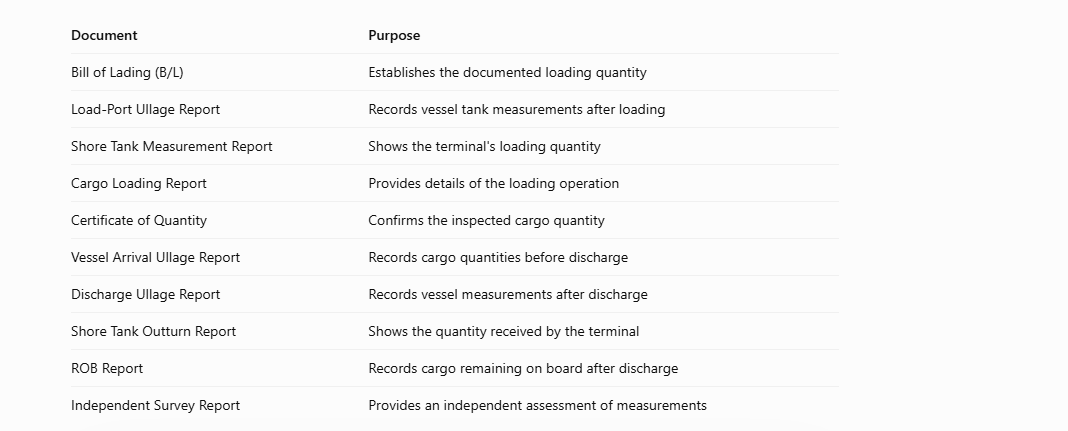
These documents should be reviewed together rather than relying exclusively on the Bill of Lading or a single ullage report.
3. How to Check Discharge Against Load-Port Records
A proper cargo reconciliation should follow a consistent process.
Step 1: Verify the Original Loading Figures
Start by reviewing the load-port records.
Check the following:
- Vessel tank numbers and individual tank measurements.
- Initial and final ullage readings.
- Cargo temperature in each tank.
- Free water measurements.
- Cargo density or API gravity.
- On-Board Quantity (OBQ) before loading.
- Shore tank measurements before and after loading.
- Total Calculated Volume (TCV) and Gross Standard Volume (GSV).
Confirm that the Bill of Lading quantity agrees with the supporting loading documentation.
Any discrepancy between ship and shore figures at the loading port should be identified before proceeding with the discharge comparison.
Step 2: Examine the Vessel’s Arrival Ullage Report
The next step is to examine the vessel’s cargo condition upon arrival at the discharge port.
Compare the arrival ullage report with the final loading ullage report.
Pay particular attention to:
- Ullage readings for each cargo tank.
- Cargo temperatures.
- Vessel trim and list.
- Free water measurements.
- Cargo density.
- Tank identification and calibration data.
- Vessel Experience Factor (VEF), where applicable.
The objective is to establish whether the cargo quantity recorded on arrival is consistent with the vessel’s departure records.
A significant difference should be investigated before discharge proceeds, subject to the applicable operating procedures and contractual requirements.
Step 3: Compare the Discharge Figures
After discharge, review the final ullage report and the Remaining On Board (ROB) report.
Check whether the vessel has discharged the expected quantity and whether any cargo remains inside the tanks.
Consider:
- Final ullage readings.
- Remaining cargo in individual tanks.
- Water and sediment measurements.
- Cargo retained in pipelines and pumps.
- Non-pumpable residues.
- Tank stripping and discharge completion records.
Cargo remaining on board should be properly measured and documented rather than automatically treated as cargo loss.
Step 4: Compare Like-for-Like Quantities
One of the most common mistakes in cargo reconciliation is comparing quantities calculated on different measurement bases.
For example, observed volume should not be directly compared with standard volume without the necessary corrections.
Where applicable, use the same:
- Measurement units.
- Reference temperature.
- Density or API gravity basis.
- Volume correction methodology.
- Water and sediment treatment.
- Applicable petroleum measurement tables.
For petroleum cargoes, API MPMS and ASTM measurement procedures provide recognised guidance for calculating and reconciling quantities.
The contractual measurement basis should determine which figures are used for the final comparison.
4. Understanding the Main Cargo Quantity Measurements
Understanding the terminology used in ullage reports is essential when investigating cargo discrepancies.
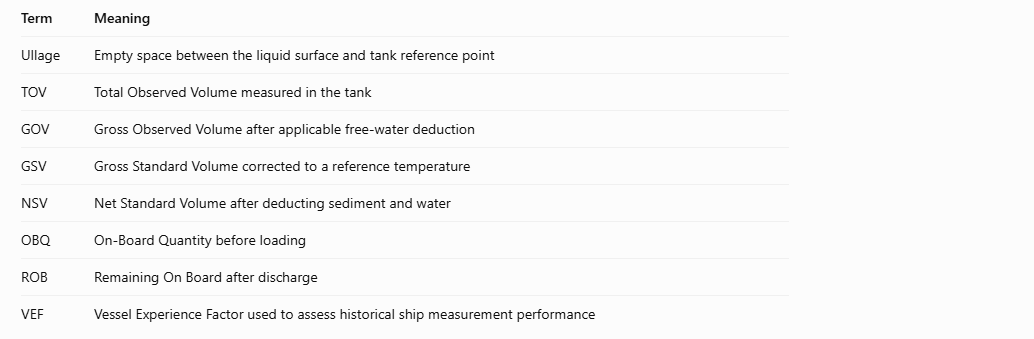
These measurements serve different purposes and should not be treated as interchangeable.
For example, a difference in observed volume may result from temperature changes rather than an actual reduction in cargo quantity. Standardised volume comparisons help reduce this type of measurement error.
5. Common Causes of Cargo Ullage Disputes
Several factors can contribute to differences between loading and discharge figures.
A. Temperature Differences
Petroleum products expand when heated and contract when cooled.
Consequently, cargo measured at a higher temperature may show a different observed volume from the same cargo measured at a lower temperature.
Temperature correction is therefore important when comparing loading and discharge quantities.
B. Incorrect Ullage Measurements
Incorrect readings can result from:
- Poorly calibrated gauging equipment.
- Incorrect tank reference heights.
- Vessel movement during measurement.
- Incorrect trim and list corrections.
- Human errors when recording measurements.
Where possible, measurements should be witnessed by an independent cargo inspector.
C. Water and Sediment Content
Water and sediment can affect the net quantity of petroleum cargo.
Free water may also accumulate during transportation, making it important to compare water measurements and supporting samples from both ports.
A difference in water content should be investigated rather than automatically classified as cargo loss.
D. Cargo Retained on Board
Some cargo may remain inside tanks, pipelines, pumps and other vessel systems after discharge.
This can happen because of:
- Incomplete tank stripping.
- Heavy or viscous products.
- Wax and sediment accumulation.
- Inaccessible tank areas.
- Ineffective pumping or draining operations.
The ROB survey helps establish whether cargo remains aboard after discharge.
E. Measurement Differences Between Ship and Shore
Shipboard measurements and shore tank measurements may not always agree.
Differences can arise from tank calibration, measurement procedures, pipeline conditions and equipment accuracy.
Both sets of records should therefore be reviewed before assigning responsibility for a shortage.
6. How to Calculate the Cargo Quantity Difference
A basic way to identify a cargo discrepancy is to compare the discharge quantity with the original loading quantity, provided both figures are expressed on the same measurement basis.
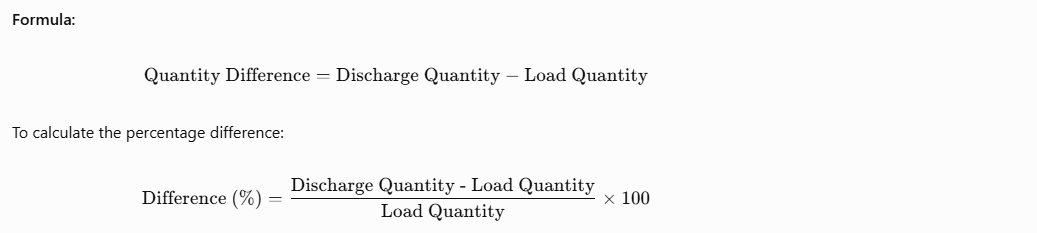
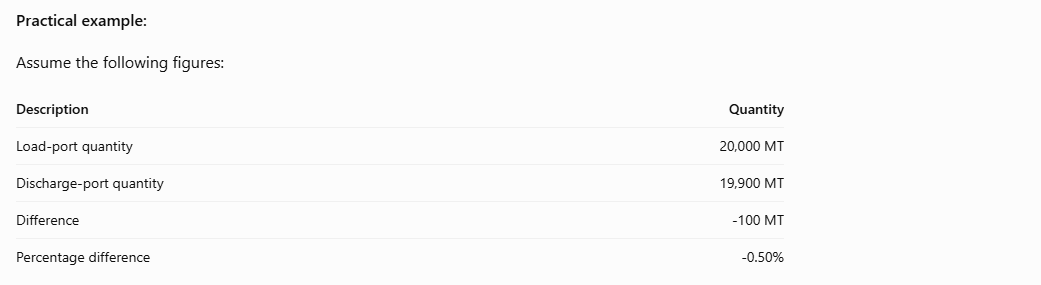
The calculation indicates a reported shortfall of 100 metric tonnes, equivalent to 0.50% of the loading quantity.
However, this calculation identifies a difference; it does not establish the cause or prove that 100 metric tonnes were physically lost.
A proper investigation should also consider the vessel’s arrival quantity, ROB, ship-to-shore differences and measurement conditions.
7. How to Resolve a Cargo Ullage Dispute
When a significant discrepancy is identified, the parties should follow a documented investigation process.
Recommended actions:
1. Notify the relevant parties: Inform the vessel’s master, charterer, cargo owner, terminal operator and appointed surveyor.
2. Request supporting records: Obtain the original loading ullage report, arrival measurements, discharge report and shore tank records.
3. Arrange an independent inspection: Where necessary, appoint an independent cargo surveyor to review the measurements and calculations.
4. Recheck the calculations: Verify temperatures, densities, tank tables, trim and list corrections and volume conversion factors.
5. Investigate ROB: Establish whether any cargo remains in the vessel’s tanks or associated systems.
6. Review operational records: Examine loading and discharge logs, pipeline records, pumping times and any operational interruptions.
7. Issue a Letter of Protest: If the discrepancy remains unresolved, formally record the disagreement and reserve the relevant parties’ rights under the contract.
A timely and properly documented investigation helps prevent disagreements from developing into more complicated commercial claims.
8. Why Independent Cargo Inspection Matters
Independent cargo inspectors play an important role in preventing and resolving ullage disputes.
Their responsibilities may include:
- Witnessing vessel and shore measurements.
- Checking tank calibration information.
- Recording temperatures and water measurements.
- Verifying cargo calculations.
- Monitoring loading and discharge operations.
- Preparing independent survey reports.
- Assisting with quantity reconciliation.
Using an independent inspector at both loading and discharge ports can improve consistency and provide stronger supporting evidence if a claim arises.
For reliable results, the parties should agree on the inspection scope, measurement procedures and applicable standards before cargo operations begin.
9. Best Practices for Preventing Future Ullage Disputes
Preventing cargo quantity disputes is generally easier and less expensive than resolving them after delivery.
Shipping companies, cargo owners and terminal operators should adopt the following practices:
- Conduct proper pre-loading and post-loading vessel inspections.
- Use calibrated and verified gauging equipment.
- Record ullage and temperature measurements for individual tanks.
- Maintain consistent measurement procedures at both ports.
- Retain cargo samples where required.
- Record OBQ and ROB accurately.
- Verify pipeline conditions before and after cargo transfer.
- Use independent inspectors for important custody-transfer operations.
- Keep complete loading, voyage and discharge documentation.
- Agree on measurement tolerances and dispute procedures in the relevant contracts.
Following these practices improves cargo accountability and reduces the risk of unnecessary financial claims.
Conclusion
Cargo ullage disputes require careful examination of loading records, vessel measurements and discharge documentation.
A difference between the Bill of Lading quantity and the discharge outturn does not automatically establish cargo loss. Temperature variations, measurement errors, water content, vessel conditions and cargo retained on board can all contribute to quantity discrepancies.
The most reliable approach is to compare the original load-port figures with the vessel’s arrival measurements, final discharge figures and shore tank records using consistent measurement standards.
For cargo owners, charterers, ship operators and terminal managers, accurate documentation and independent inspection are essential to protecting commercial interests and resolving quantity disputes.
Ultimately, proper cargo reconciliation helps improve transparency, minimise financial exposure and maintain confidence throughout the petroleum shipping and logistics chain.